
Your Company Page Is Reaching 1.6% of Your Followers. That Number Will Not Recover.
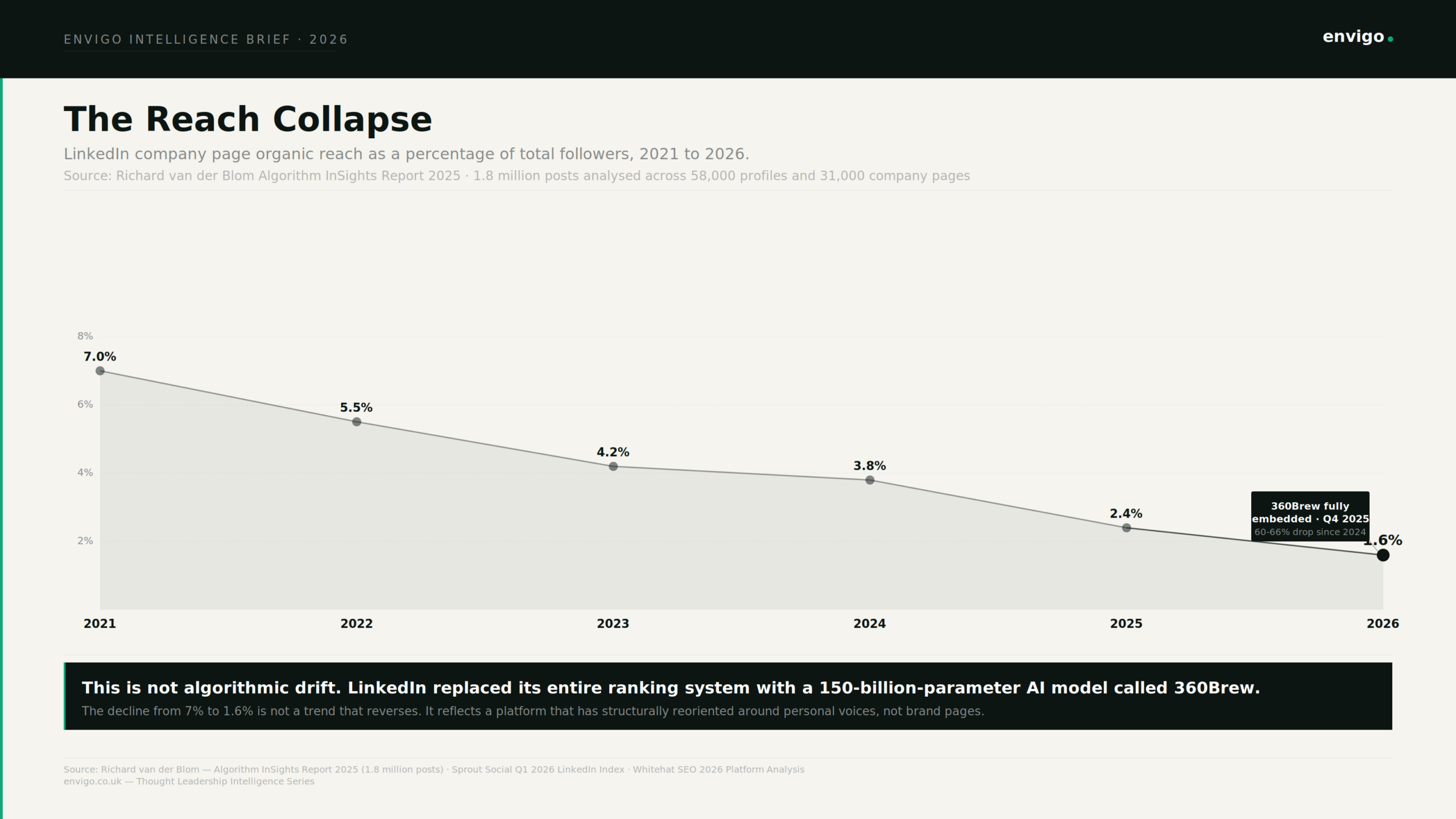
Richard van der Blom’s Algorithm InSights 2025 report, analysing 1.8 million posts across 58,000 profiles and 31,000 company pages, found that company page posts now reach roughly 1.6% of their followers. Organic company page content makes up just 1 to 2% of the LinkedIn feed, down from 7% in 2021. Nexos
A company page with 10,000 followers is reaching 160 people per post. Most of those 160 are not buyers.
Organic reach for company pages plummeted between 60% and 66% from 2024 to early 2026. This is not a temporary dip or seasonal fluctuation. LinkedIn has fundamentally restructured how it distributes company content in user feeds. The post that reached 10,000 people in 2024 now reaches 4,000 with the same follower count. UX Design
Understanding why this happened, and what it means for how B2B brands operate on the platform, requires understanding what LinkedIn actually replaced.
What Changed Is Not the Settings. It Is the System.
LinkedIn has rolled out its biggest algorithm overhaul in history, a 150-billion-parameter AI model called 360Brew. First introduced in a research paper in January 2025 and deployed throughout the year, it reshaped how content gets distributed across the platform. By Q4 2025, it was the algorithm. In mid 2026, it is fully embedded. Fullstory
The old ranking system counted signals. Likes, comments, shares, and posting speed in the first hour. It rewarded volume, timing, and engagement hacks. A company could game it by building pods, scheduling content at peak times, and generating fast initial reaction. 360Brew does not count what happens around your content. It reads the content itself, evaluates who wrote it, and decides whether it belongs in front of a relevant audience of potential clients and decision-makers. Harvard Business Review
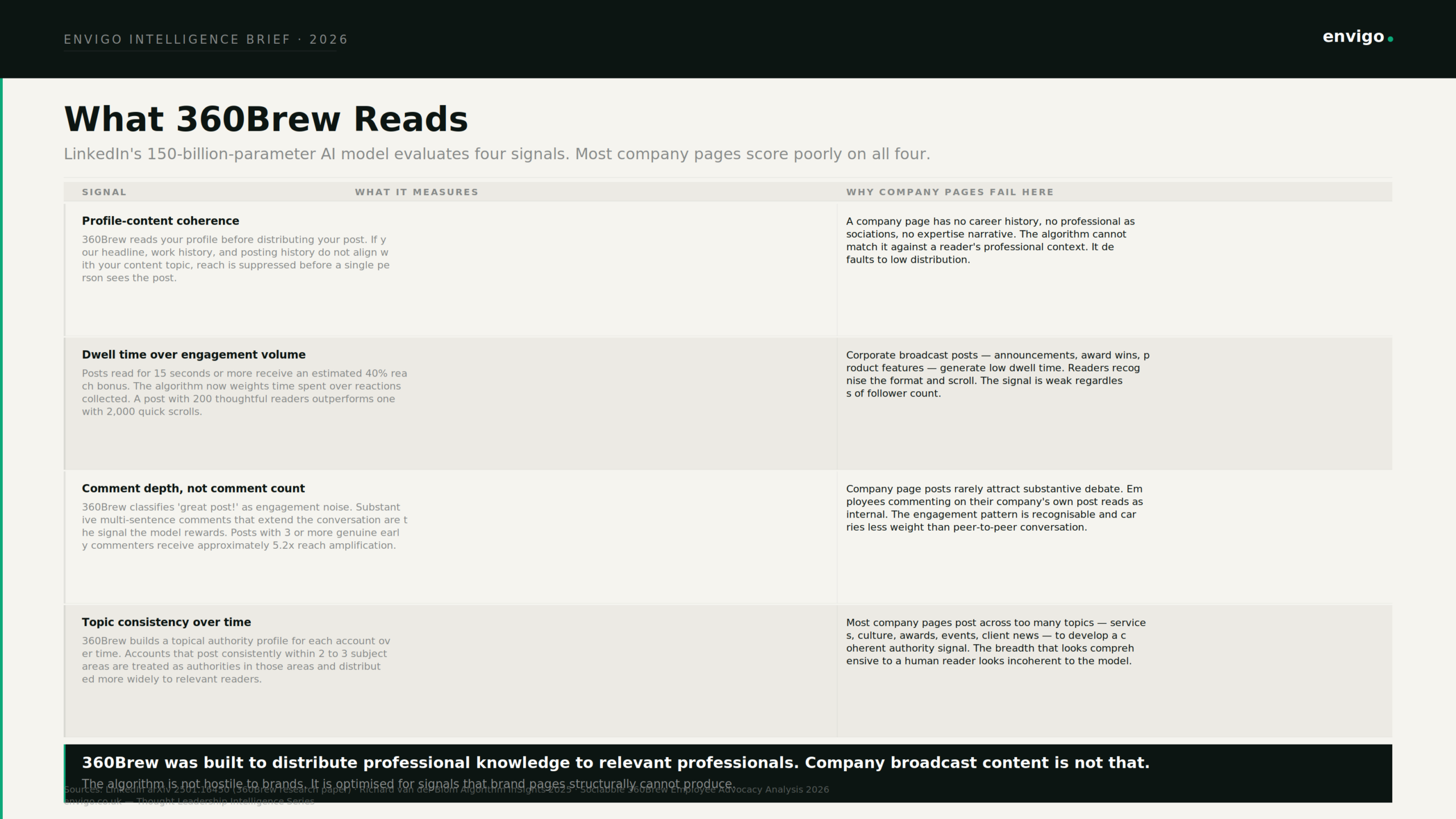
The algorithm reads your profile before it decides how far your posts travel. It builds a topical authority profile for each account based on posting history, headline, work experience, and network relevance. If those signals align with the content, the post travels. If they do not, it is suppressed before the first impression is served. WorkOS
A company page has no career history, no professional associations, no expertise narrative the model can work with. It cannot match a brand account against a reader’s professional context the way it can match a senior engineer’s post to an audience of engineers in adjacent roles. The structure that made company pages work under the old algorithm is the same structure that makes them invisible under the new one.
The Four Signals 360Brew Evaluates
| Profile-content coherence
A company page has no career history, no professional associations, no point of view the model can match against a reader’s professional profile. LinkedIn’s ranking system is designed to find the right professional knowledge for the right professional reader. A brand page posting “Excited to share our latest case study” provides nothing for the algorithm to work with. John Dawes |
Topic consistency over time
360Brew rewards consistent posting within two or three subject areas. It treats accounts that do this as topical authorities and distributes their content more widely to relevant readers. Most company pages post across too many topics (services, culture, awards, client news, events) to develop a coherent authority signal. The breadth looks comprehensive to a human reader. To the model it looks incoherent. Talyx AI |
| Dwell time over engagement volume
A post someone reads for 15 seconds receives an estimated 40% reach bonus. The model weights time spent over reactions collected. A post with 200 thoughtful readers outperforms one with 2,000 scroll-pasts who tapped like on their way through the feed. Corporate announcements, award posts, and product features generate low dwell time because readers recognise the format instantly and move on. |
Comment depth instead of comment count
360Brew classifies “great post!” as engagement noise. Saves are now the highest-value engagement signal, estimated at five to ten times the weight of a like. Substantive multi-sentence comments are what the model rewards. Posts with three or more genuine early commenters receive approximately 5.2x reach amplification, a window where personal profiles structurally outperform brand pages because peers comment on peers more readily than they comment on corporate content. Harvard Business ReviewSranalytics |
The algorithm is not hostile to marketers. It is hostile to manipulation, and that distinction is the foundation of every effective LinkedIn strategy in 2026. WorkOS
What Still Works at Scale
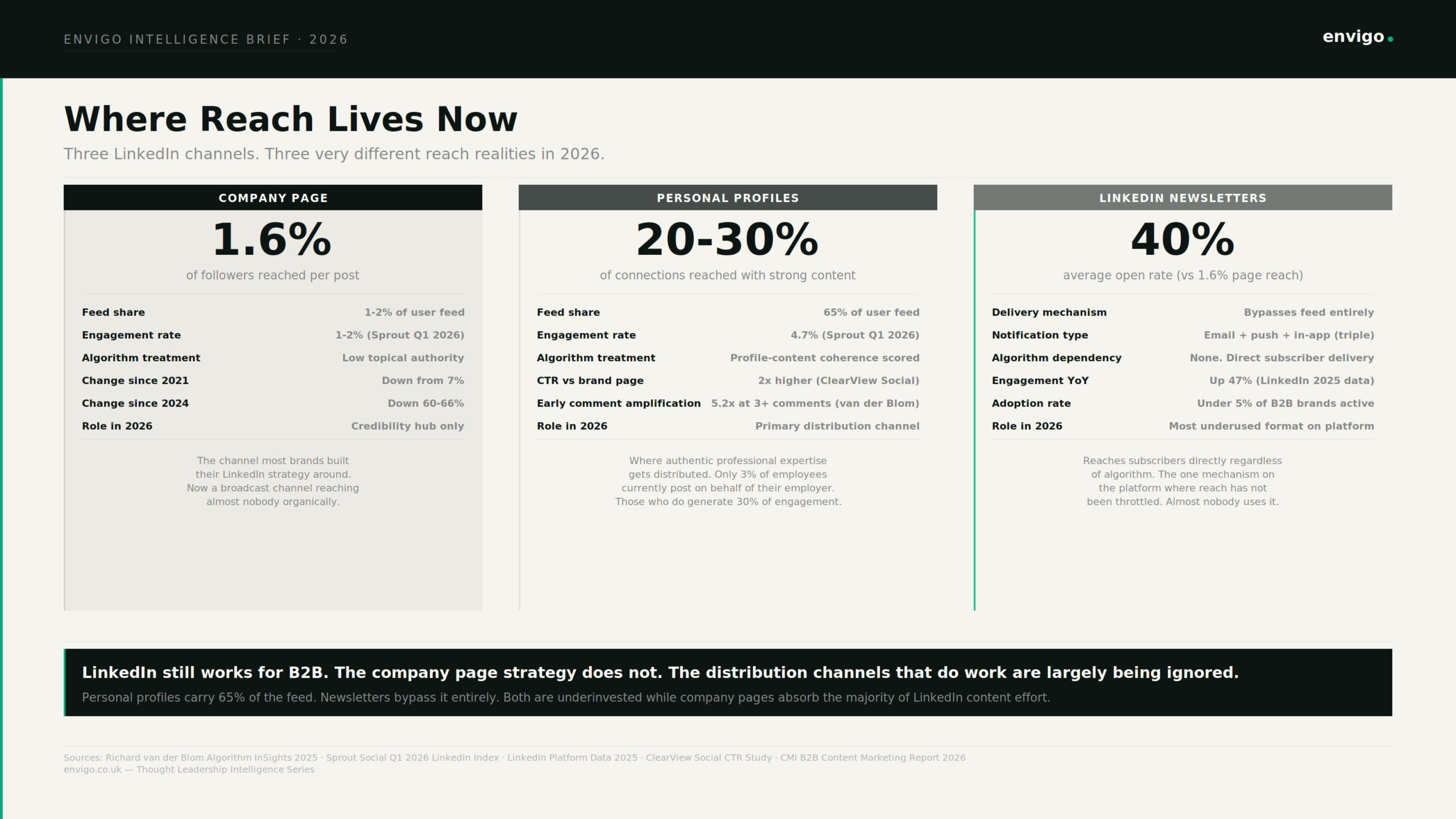
Personal profiles now get approximately 13 times more reach than company pages. Personal profiles dominate 65% of feed content. Company pages account for roughly 5%. The asymmetry is the strategic reality every B2B brand needs to build around. The Re-Wired Group
Only 3% of employees share company content, but those shares generate approximately 30% of total engagement. Employees have 10 times more connections than company followers. Employee-shared content drives twice the click-through rate of branded content. 92% of B2B buyers trust employee recommendations over traditional advertising. Kaizenko
The brands generating meaningful organic reach on LinkedIn in 2026 have largely stopped treating company pages as distribution engines. They are using personal profiles (their founders, senior practitioners, and subject-matter experts) as the primary channel and routing the best content through people rather than logos. The brands maintaining visibility on LinkedIn in 2026 are the ones who turned their employees into a coordinated content distribution network. UX Design
The second mechanism most brands have not built is the newsletter. LinkedIn newsletters saw a 47% engagement increase, achieving roughly 40% open rates through a triple notification system of email, push, and in-app alerts that bypasses algorithmic limitations entirely. While every other organic reach mechanism on the platform has been throttled, newsletters operate on a direct subscription model. The subscriber asked to receive it. The algorithm has no involvement. Under 5% of B2B brands have an active newsletter. The gap between the reach it generates and the investment it receives is the clearest inefficiency in B2B content right now. Summit Partners
The company page still has a role. It is the credibility infrastructure. The place a buyer goes to verify that the person they found on LinkedIn is attached to a real, established organisation. Case studies, about pages, job postings, and service descriptions all belong there. Distribution does not.
The Strategic Question This Raises
Most B2B content strategies were built around a platform that rewarded broadcast. Post to your company page, build your follower count, measure impressions. The model made sense when 7% of followers saw each post. It is difficult to justify when that number is 1.6% and falling.
Employee advocacy programmes that equip employees to personalise and author content rather than just click share from company pages are the ones that generate measurable LinkedIn reach. The platform used to count signals. Now it reads content. A programme built for the old version of LinkedIn is accelerating the decline for every employee who participates. Harvard Business Review
The question is not whether LinkedIn still works for B2B. 53% of B2B professionals rank it the most important social media platform. Four out of five members drive business decisions. Its audience has twice the buying power of the average web audience. The audience is there. The attention is there. The reach mechanism most brands are relying on to access it is not. MiniMBA
360Brew was built to distribute professional knowledge to relevant professionals. The brands that will benefit from it are the ones that accept that premise and build their strategy accordingly. People with genuine expertise, posting with their own voice, on topics they are actually qualified to address. That is what the algorithm rewards. It is also, not coincidentally, what buyers trust.
Sources: Richard van der Blom – Algorithm InSights Report 2025 (1.8 million posts) · LinkedIn arXiv 2501.16450 (360Brew research paper) · Sprout Social Q1 2026 LinkedIn Index · Whitehat SEO 2026 Platform Analysis · Sociabble 360Brew Employee Advocacy Analysis 2026 · ClearView Social CTR Study · CMI B2B Content Marketing Report 2026 · Dataslayer LinkedIn Format Benchmarks April 2026
Where to go next
If you’re dealing with comparable constraints, we’re open to a conversation.