
AI for Efficiency Was Easy to Justify. AI for Effectiveness Is a Harder and More Important Problem.
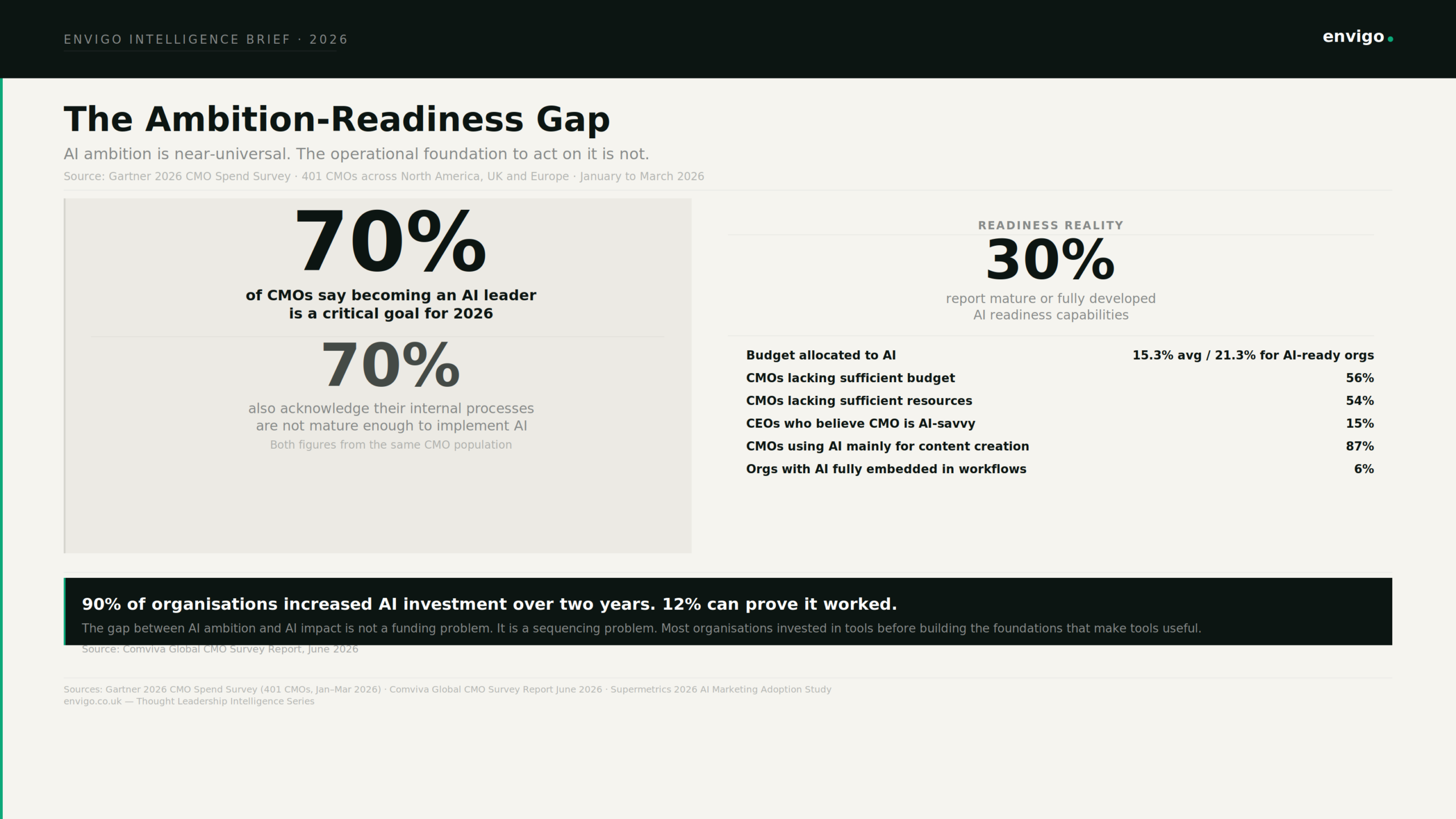
90% of organisations increased their AI marketing investment over the past two years. 12% can prove it worked. That single finding from Comviva’s Global CMO Survey, published in June 2026, describes the defining condition of AI in marketing right now. Near-universal investment. Rare demonstrable impact. PR Newswire
CMOs are already allocating 15.3% of marketing budgets to AI initiatives, with marketing leaders expecting that figure to reach 31 to 32% of overall marketing budgets within five years. The money is moving. The results are not following at the same rate. Gartner
Understanding why requires being specific about what most of that investment is actually buying.
What AI for Efficiency Looks Like in Practice
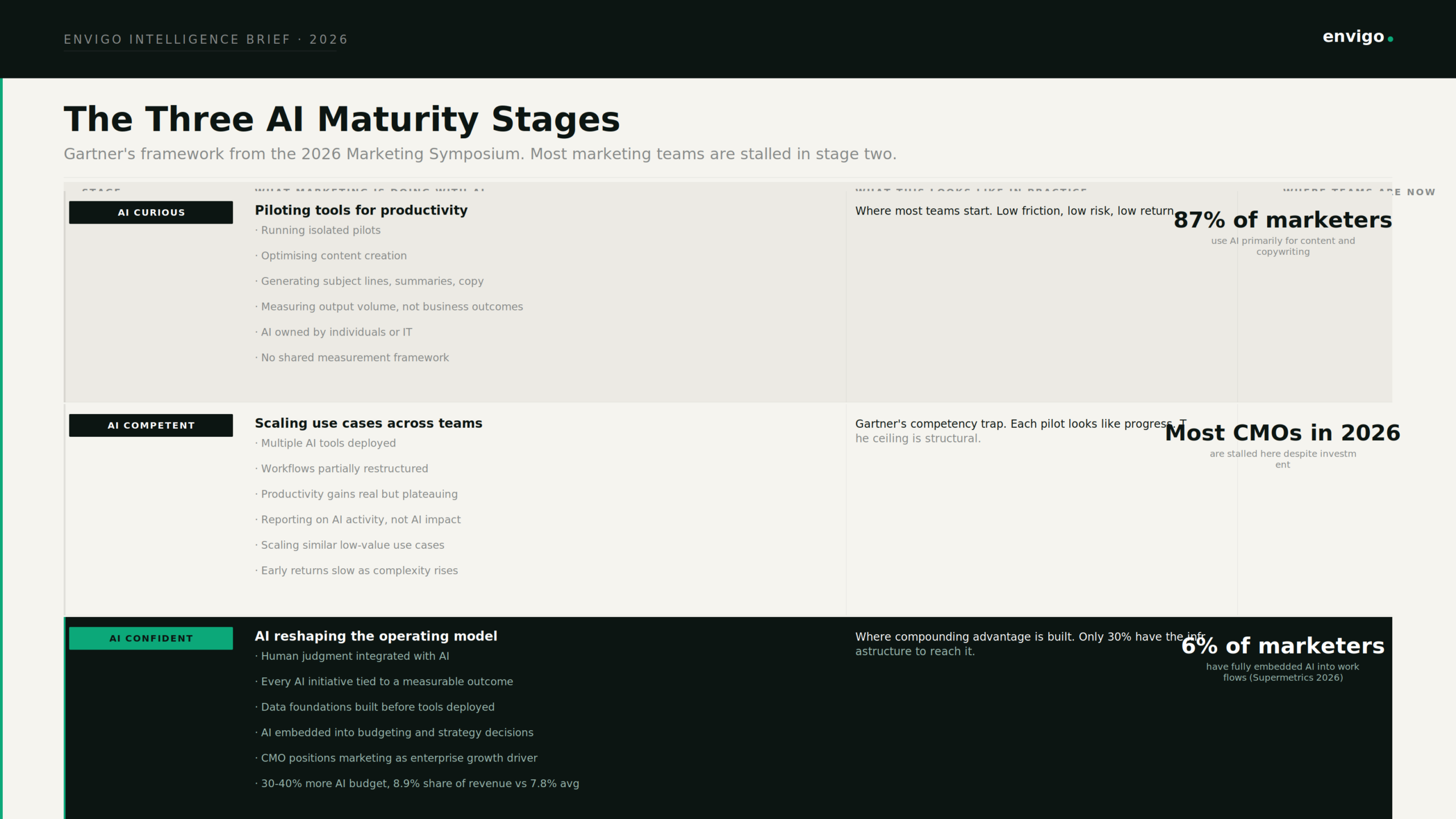
87% of marketers use AI primarily for content creation and copywriting, the low-value, repetitive end of the work. Only 6% of marketers have fully embedded AI into their workflows. Digital Applied Team
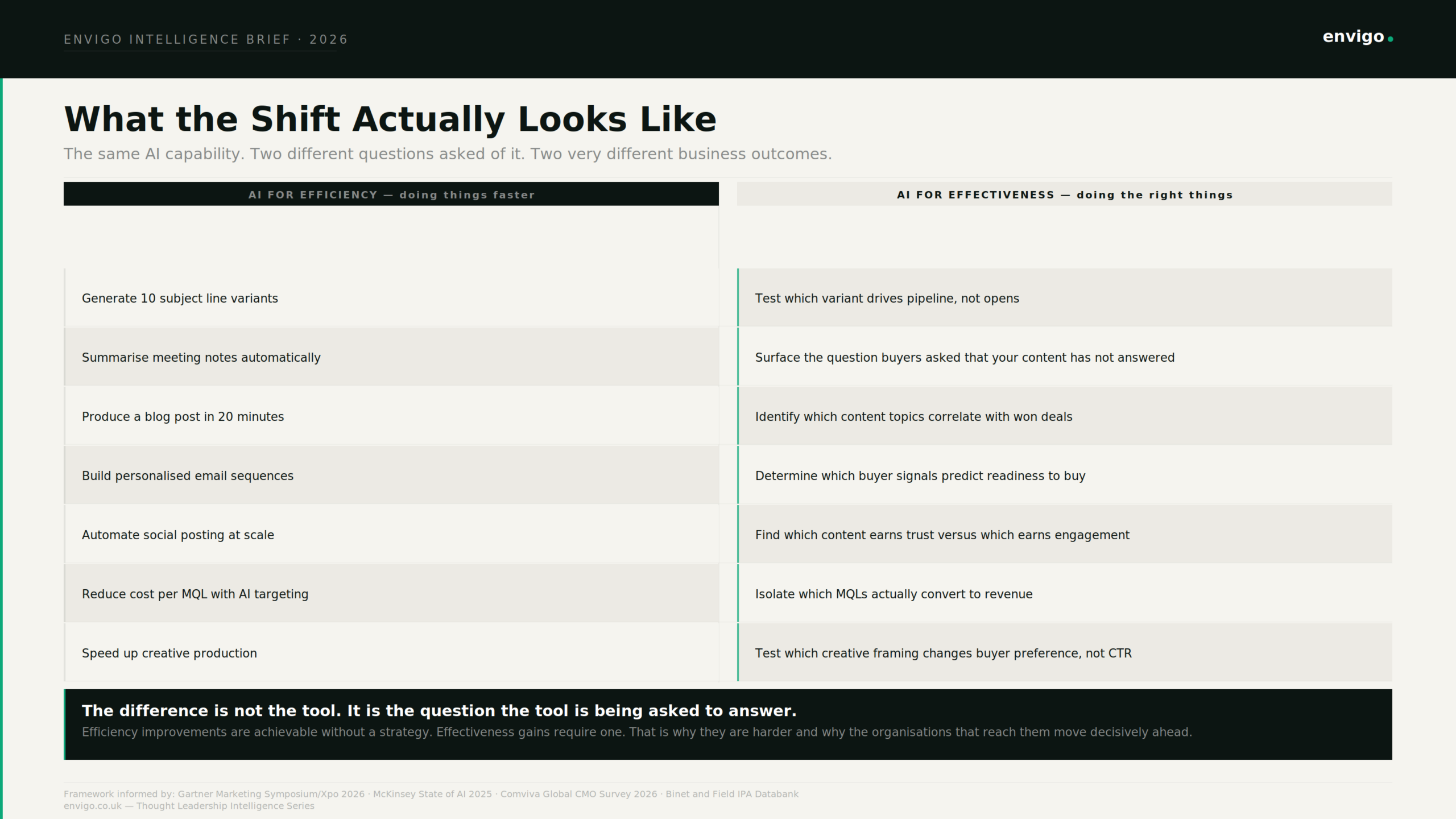
Content faster. Emails at scale. Subject line variants. Meeting summaries. Social posts without the wait. These are genuine productivity gains. A team that used to spend three hours producing a content brief now spends 40 minutes. That is real. The problem is what it does and does not change.
Efficiency improvements reduce the cost of doing what you were already doing. They leave the strategic question, whether what you were doing was the right thing, entirely unanswered. A marketing team producing mediocre content at twice the speed is producing twice as much mediocre content. An email programme with weak segmentation, automated at scale, reaches more of the wrong people faster. The efficiency is real. The direction is unchanged.
This is why Gartner’s opening keynote at Marketing Symposium/Xpo 2026 argued that AI competence does not make a CMO AI confident. The early wins are not the destination. They are the starting point, and treating them as the destination is specifically what stalls progress. CMSWire
The Competency Trap
CMOs who fail to move beyond early AI use cases risk getting stuck in costly AI competency traps, while a small but growing group of market-shaper CMOs are using AI to drive enterprise growth, customer confidence, and competitive differentiation. Gartner
Gartner’s framing of this trap is precise. Teams that scale similar low-value use cases hit diminishing returns because the work being automated was never the constraint. Moving from pilots to enterprise value rarely fails on model quality and usually fails on operationalisation. The common failure points are fragmented data, insufficient measurement infrastructure, and AI outputs that are not embedded into the downstream workflows that actually move revenue or retention. Let’s Data Science
The trap has a specific shape. A team runs a content AI pilot. Results look good, time saved, volume up. They scale it. They run a personalisation pilot. They add an automated reporting tool. Each pilot is a real project. Each produces a number that looks like progress. The aggregate produces very little that is visible at the level of pipeline or revenue, because the question being asked of AI across all of these projects is the same: how do we do this faster? The more important question, whether this is worth doing at all, and whether AI can help us find out, goes unasked.
84% of brands are trapped in a doom loop where underfunded marketing measurement makes it harder to prove results, leading to tighter budget allocations in subsequent cycles. The competency trap and the measurement doom loop reinforce each other. Teams cannot prove AI impact because they are measuring AI activity. They cannot improve measurement because the AI investment went into production, not insight. ALM Corp
What the Credential Gap Signals
Only 15% of CEOs believe their marketing leaders are currently AI-savvy. By 2027, a lack of AI literacy is predicted to rank among the top three reasons CMOs are replaced at large enterprises. ALM Corp
This is not about whether CMOs understand the technology. Most do, at a sufficient level. It is about whether they are using AI to change the quality of the decisions they make, rather than the speed at which they execute decisions already made.
Gartner used GE HealthCare as an example of using AI for context rather than content volume. Rather than asking AI to generate more role-based content, GE HealthCare used AI to surface natural language questions from sales and service conversations, analytics tools and simulated buyer behaviour. It then mapped those questions to buying-stage intent. The output was not more content. It was a clearer view of what buyers needed to understand, at each stage, before they were ready to move. The AI answered a strategic question rather than a production one. CMSWire
That distinction separates the 6% with AI fully embedded in workflows from the 87% still primarily using it for content creation. The tool is often identical. The question being asked of it is entirely different.
What AI for Effectiveness Actually Requires
Every AI budget line should be tied to a specific workflow, metric, or customer outcome. The organisations pulling ahead are those that have moved from running pilots to running repeatable, measurable AI-powered workflows. Spark Novus
Three conditions separate AI-for-effectiveness programmes from AI-for-efficiency ones.
The outcome is defined before the tool is selectedThe question is not “what can we do with this AI platform?” It is “what do we need to know or change to improve this outcome, and can AI help us find out?” This sounds simple. It is structurally different from how most AI purchasing decisions happen, which start with a vendor conversation and work backwards to a use case. |
Data foundations precede deploymentMarketing organisations may invest in AI tools faster than they build the data foundations, processes, governance and talent required to scale them. This is where many AI roadmaps become fragile. AI-ready organisations (the 30% Gartner identifies as having mature capabilities) allocate 21.3% of their marketing budgets to AI versus the 15.3% average. They also carry higher internal marketing budget allocations overall. The investment in foundations is what enables the rest. ContentGrip |
The measurement infrastructure connects AI outputs to business outcomesSignals that a team is escaping the competency trap include a shift from output metrics to outcome metrics, end-to-end measurement pipelines, and causal testing that ties AI interventions to revenue or retention. Without this, there is no way to know whether the AI initiative is producing effectiveness gains or just producing outputs that look like them. Let’s Data Science |
The Window This Creates
Marketing leaders expect AI-driven automation of marketing work to more than double, from 16% in 2026 to 36% by 2028. That trajectory is real, but it is not evenly distributed. The AI-confident teams reshaping their operating models pull the average up. The AI-curious and AI-competent teams stuck in the competency trap contribute little of the gain. The doubling happens, but it is unevenly distributed and the distribution is decided by who built the foundation first. GartnerDigital Applied Team
The two-year window between now and 2028 is not the window to add more pilots. It is the window to answer the harder question. Not how to do marketing faster, but how to use AI to find out what marketing should be doing in the first place. The teams that make that shift accumulate a data and measurement advantage that later entrants cannot quickly buy. The most advanced CMOs are not spending more on AI. They are spending differently. Creating budget agility, innovation capacity and operating discipline needed to turn AI investment into measurable business impact. Spark Novus
The efficiency case for AI was straightforward and largely won. Every vendor made it. Every team felt it. The effectiveness case is harder because it requires being honest about whether the current marketing strategy is good enough to be worth executing faster and building the infrastructure to find out.
That is the more important problem. Most organisations have not started on it yet.
Sources: Comviva Global CMO Survey Report June 2026 · Gartner 2026 CMO Spend Survey (401 CMOs, Jan-Mar 2026) · Gartner Marketing Symposium/Xpo keynote June 2026 · Supermetrics AI Marketing Adoption Study 2026 · McKinsey State of AI 2025 · CIM European Marketing Report February 2026
Where to go next
If you’re dealing with comparable constraints, we’re open to a conversation.