
The Funnel Is a Lie. Buyer Behaviour Has Always Been Non-Linear.
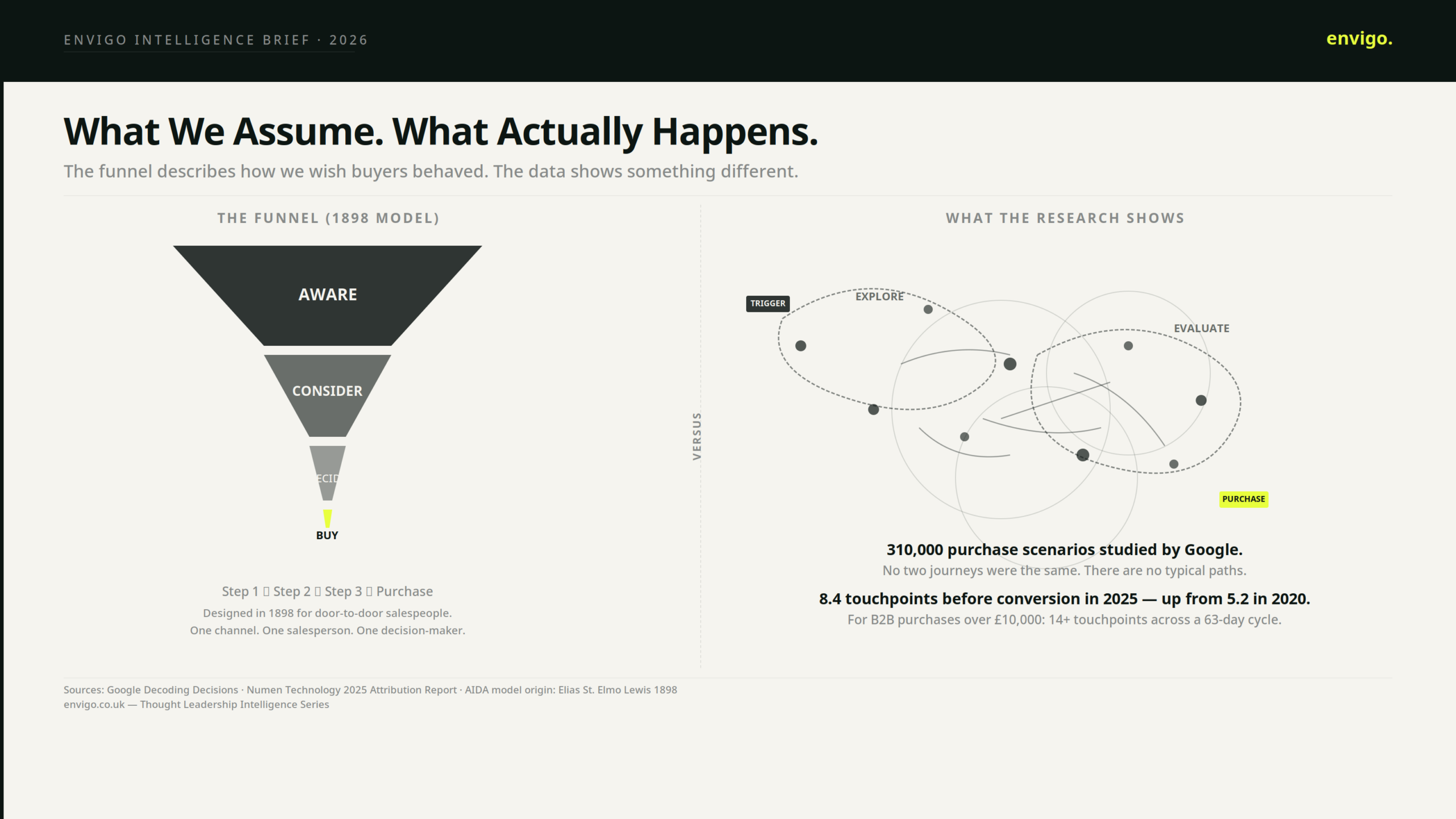
The marketing funnel is 128 years old. It was designed in 1898 for door-to-door salespeople, in a world where the fastest car reached 39 mph and the telephone was still a luxury. We have been running digital marketing strategy through it ever since.
This is not a provocation. It is a description of what happened, and it explains a great deal about why so much marketing investment produces so little that connects to revenue.
Where the Funnel Came From
Elias St. Elmo Lewis created the AIDA model in 1898 to explain how a single salesperson, in a single conversation, should move a single buyer from awareness to action. William Townsend added the funnel shape in 1924. His framing was explicit: a salesperson should visualise the selling process as “forcing by compression of a broad and general concept of facts through a funnel.”
Single channel. Single salesperson. Single decision-maker. Sequential, linear, controlled.
This is the architecture beneath every stage-gated campaign, every lead-scoring model, and every dashboard that measures awareness, consideration, and conversion as if they happen in that order.
They do not.
What the Research Actually Shows
Google studied 310,000 purchase scenarios across financial services, retail, travel, and consumer goods. The research team described what they saw as “spaghetti.” There were no typical journeys. Buyers moved fluidly between two mental states. Exploration and evaluation. Looping back and forth multiple times before any purchase occurred.
During this “messy middle,” 25% of buyers switched to their second-favourite brand simply from seeing its name and logo. The journey was not progressing through stages. It was a web of exposures, comparisons, doubts, reassurances, and returns.
The numbers behind modern B2B buying confirm the same pattern. 80% of the B2B journey now happens before any contact with a vendor (Gartner, 2024). 92% of buyers start with a vendor already in mind before formal evaluation begins (Forrester, 2024). 73% of B2B buyers are millennials who grew up with self-directed digital research and expect to conduct it without interference from sales.
By the time a buyer fills out your form, the decision is largely made. The funnel does not capture this. It starts where the journey ends.
The Measurement Problem
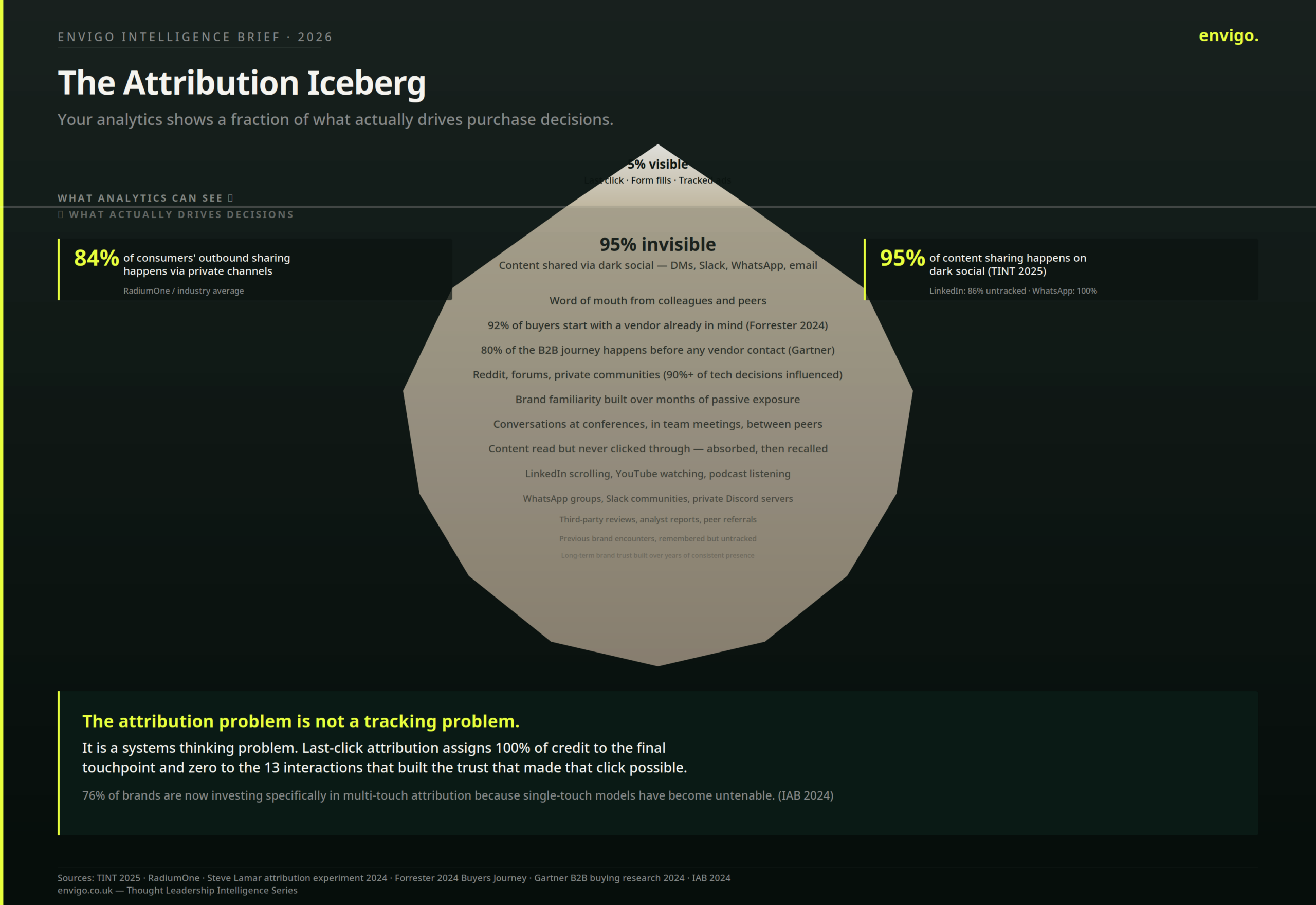
Buyers interact with an average of 8.4 touchpoints before converting in 2025, up from 5.2 in 2020. For B2B purchases over £10,000, that figure reaches 14 or more touchpoints across a 63-day cycle. Most of those touchpoints are invisible to standard analytics.
95% of content sharing happens through dark social. Direct messages, Slack channels, WhatsApp groups, private emails, Discord servers. A recommendation from a trusted colleague in a Slack thread, a case study forwarded between three people who never touched your CRM, a conversation at an industry event: these are the moments where preference is built and decisions are shaped. They register in your analytics as direct traffic or not at all.
Last-click attribution assigns 100% of conversion credit to the final touchpoint and zero to the 13 interactions that built the trust that made that click possible. 76% of brands are now investing in multi-touch attribution specifically because single-touch models have become untenable (IAB, 2024). The model is broken. Most marketing teams already know it.
Why Marketers Keep the Funnel Anyway
Funnels are comfortable. They make forecasting easier. They produce clean slides. They give the illusion of control over a process that is, in reality, distributed across channels and conversations that no marketer can own or fully observe.
87% of marketing leaders experienced campaign performance issues in 2024, with over half reporting problems across every stage of the customer journey. Marketing budgets fell 15% while CEO growth expectations continued to rise. The funnel is not solving this. It is producing the conditions for it. Campaigns optimised for stages that buyers are not actually moving through, investment allocated by what can be tracked rather than what is actually driving decisions.
What High-Performing Marketing Teams Are Built to Do Differently
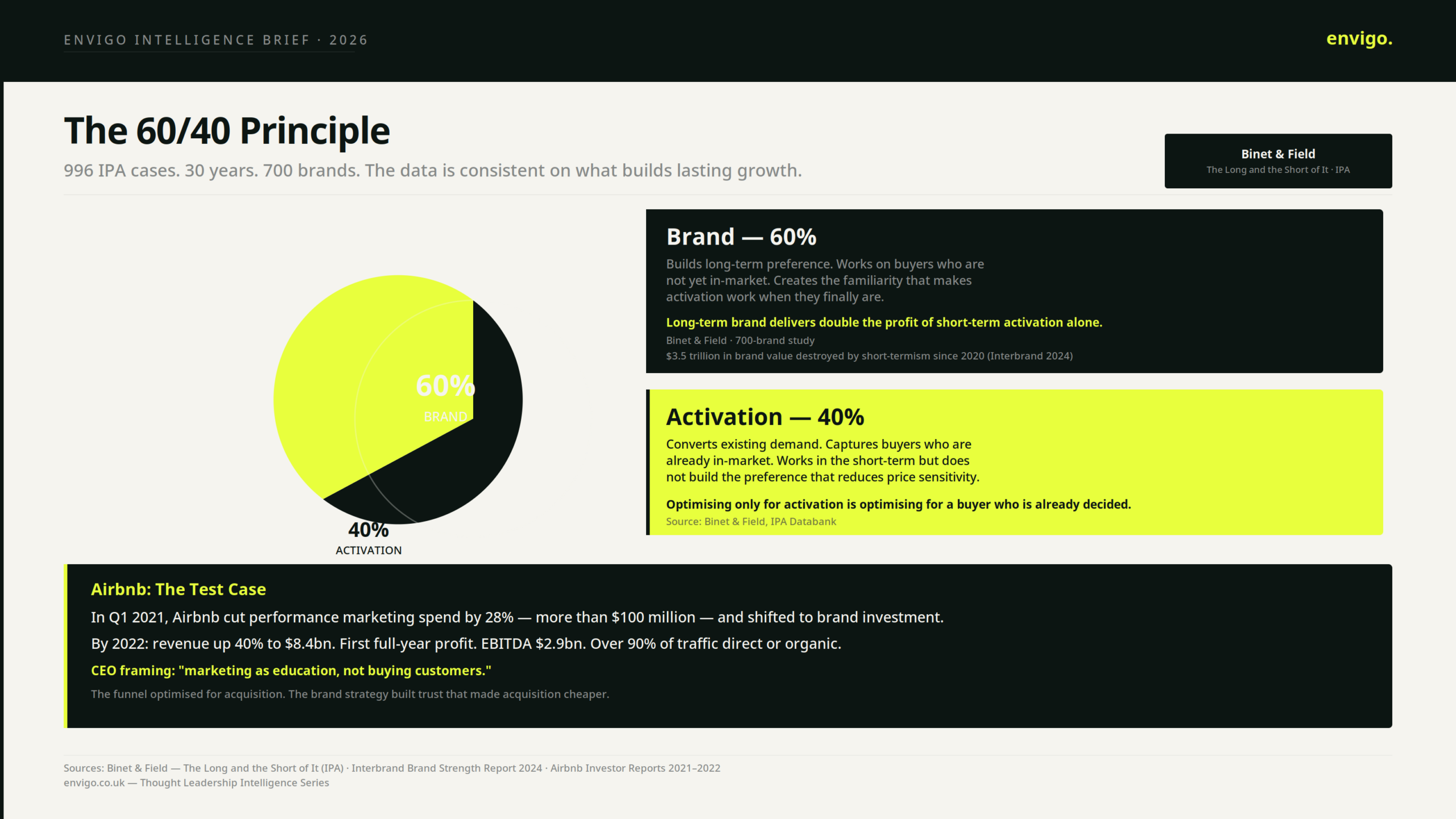
The research on this is 30 years old and consistent. Binet and Field analysed 996 IPA case studies across 700 brands and found that the optimal marketing investment split is 60% brand, 40% activation.
Brand investment works on buyers who are not yet in-market. It builds the familiarity, trust, and preference that make activation cheaper and more effective when those buyers eventually are ready. Long-term brand investment delivers double the profit of short-term activation alone.
Activation works on existing demand. It converts buyers who are already looking. The error most marketing teams make is optimising entirely for activation, for what can be tracked and attributed, while underinvesting in the brand presence that shapes preference before demand surfaces.
Forrester calls the alternative “preference marketing”: proactively shaping buyer perception before active demand appears. 92% of buyers start evaluation with a vendor already in mind. The question is whether your brand is already there when that preference forms, or whether you are only showing up after someone else has already occupied that position.
Airbnb tested this at scale. In Q1 2021, the company cut performance marketing by more than $100 million and shifted to brand investment. By 2022, revenue had grown 40% to $8.4 billion, the company recorded its first full-year profit, and over 90% of traffic was direct or organic. The CEO framed the shift as “marketing as education, not buying customers.”
The funnel optimised for acquisition. The brand strategy built the trust that made acquisition cheaper.
The funnel was never wrong. It described something real. A single conversation, in a single channel, with a single buyer. That world no longer exists. Buyers research across 10 or more channels. 6 to 10 stakeholders are involved in most B2B decisions. 70% of the journey is complete before any vendor contact. Dark social carries the conversations that matter most.
A framework built for one channel, one salesperson, and one decision-maker is not a useful architecture for this environment. The organisations ahead in marketing have not found a better funnel. They have stopped thinking in funnels at all. Building instead for presence, for trust, and for the kind of brand familiarity that means they are already in the conversation before it officially begins.
Sources: Google Decoding Decisions · Binet and Field, The Long and the Short of It (IPA) · Forrester 2024 Buyers Journey Survey · Gartner B2B Buying Research 2024 · LinkedIn 2025 B2B Buyer Report · Interbrand 2024 · Airbnb Investor Reports 2021–2022 · TINT Dark Social Report 2025 · Numen Technology Attribution Report 2025 · IAB 2024
Where to go next
If you’re dealing with comparable constraints, we’re open to a conversation.