
Paid Search Is a Tax on Weak Brands. Most Organisations Are Paying More of It Every Year
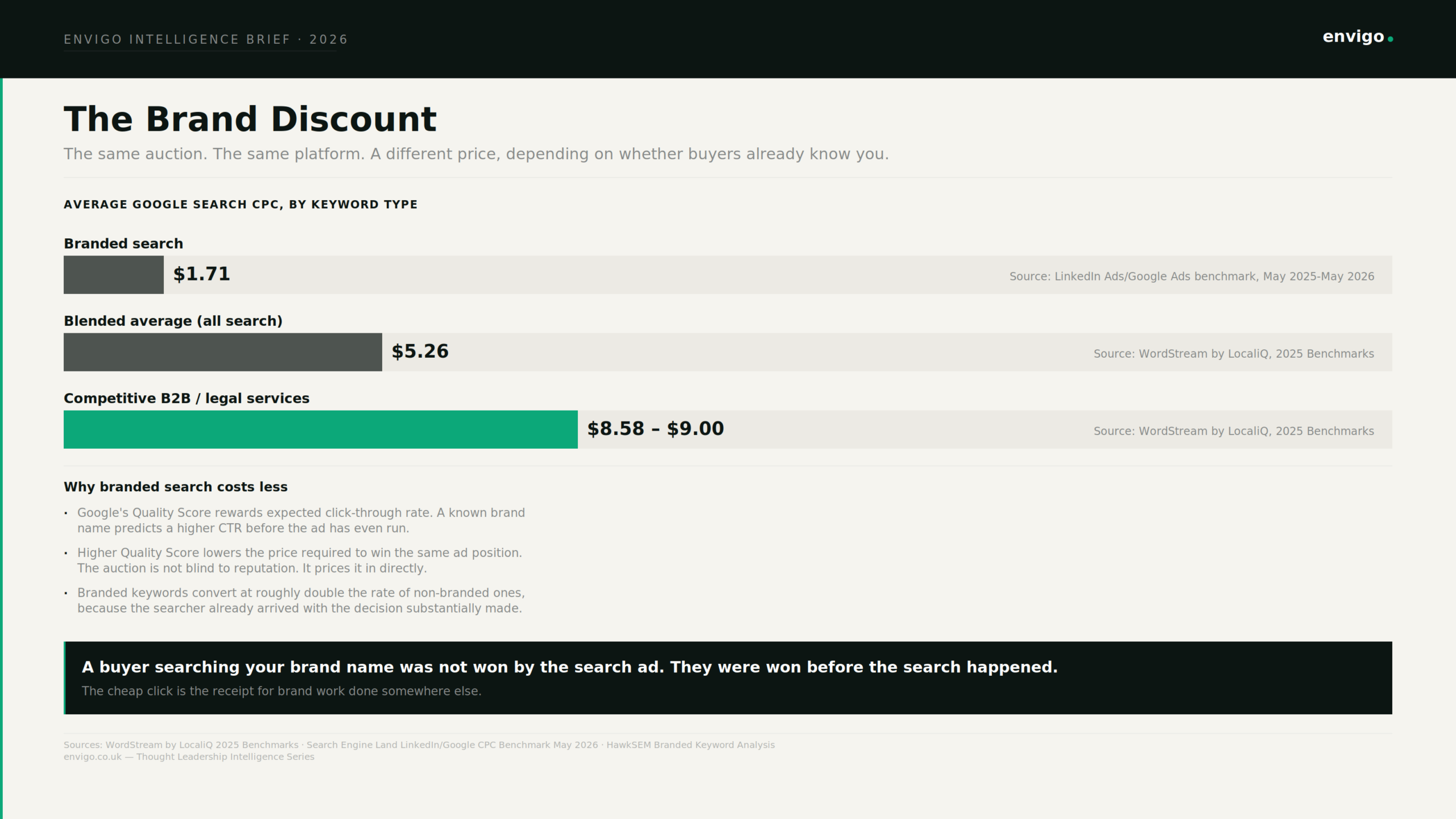
Nearly 87% of industries saw year-over-year CPC increases in 2025, with the cross-industry Google Ads average reaching $5.26 per click. The most competitive B2B categories now approach $8 to $9 per click. Every marketing leader running paid search has felt this. The standard response is to optimise. Tighten match types. Refine negative keyword lists. Improve Quality Score. Test new ad copy.
These actions help at the margins. They do not address what the rising number is actually measuring.
The Same Auction Charges Two Different Prices
Branded search keywords cost roughly $1.71 per click on average, compared with the $5.45 blended average across all Google Ads campaign types. That is not a small gap. It is a brand searching for itself paying less than a third of what the same platform charges for generic category terms.
The mechanism behind this is not a discount Google extends as a courtesy. Quality Score is built substantially around expected click-through rate, and the higher your Quality Score, the lower your CPC becomes for the same ad position. A search engine predicting how likely an ad is to be clicked will predict a higher rate for a name searchers already recognise than for one they have never encountered. That prediction becomes a price. Branded keywords also convert at roughly double the rate of non-branded ones, because the person searching your name has typically already decided you are worth considering before they typed anything.
None of this is hidden. It is published in Google’s own documentation of how Quality Score works. What is less commonly discussed is the implication: every organisation running paid search is being charged a price that reflects how well-known it already is. The brands paying the highest CPCs in their category are not unlucky with the algorithm. They are paying the price the algorithm calculates for being relatively unknown.
The Tax Rate Is Rising for Everyone, Faster for the Unrecognised
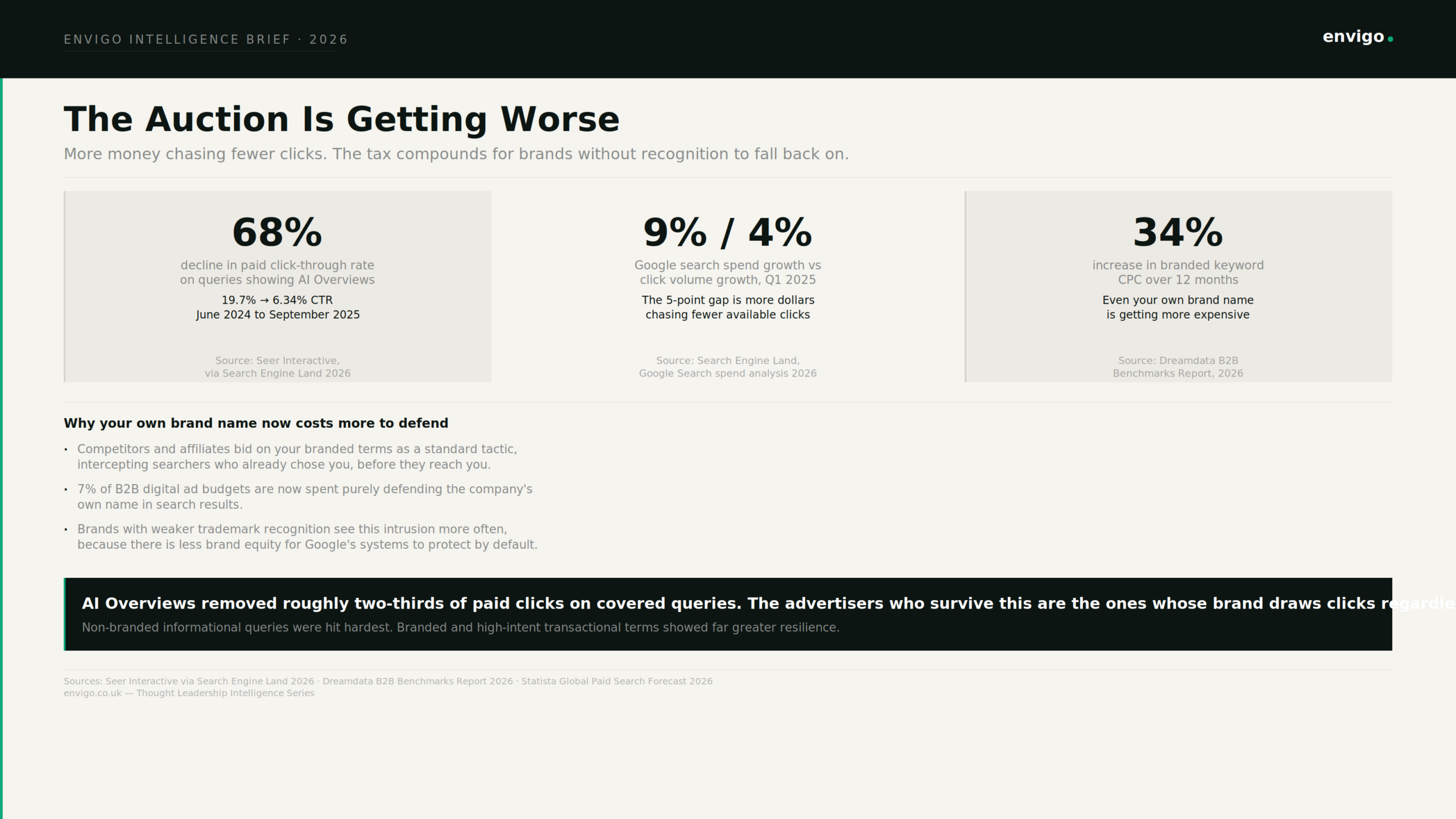
Paid click-through rate on queries that triggered AI Overviews collapsed from approximately 19.7% to 6.34% between June 2024 and September 2025, a 68% decline. Google Search spend grew 9% year-over-year in Q1 2025 while click growth was only 4%. That five-point gap represents more advertising dollars chasing a shrinking supply of clicks.
The effect of this is not evenly distributed. The decline in response rates has been most severe for non-branded informational queries, while branded search and high-intent transactional queries have shown far greater resilience. AI Overviews answer the generic question directly on the results page, removing the click entirely for searchers who were never going to buy anything specific. The branded searcher, who already knows what they want, clicks through regardless.
Even defending your own name is no longer cheap. Branded search ad CPCs increased 34% over a recent 12-month period, partly because bidding on competitors’ brand names has become a standard competitive tactic, and partly because broad match settings can automatically enter advertisers into auctions for terms adjacent to a competitor’s brand. A significant 7% of B2B digital advertising budgets are now spent purely protecting a company’s own brand name in search results. A brand with weak trademark recognition and limited search presence is more vulnerable to this intrusion. There is less established brand equity in the auction for Google’s systems to treat as a settled signal, which leaves more room for a competitor’s bid to compete for that searcher’s attention.
The structural trend in paid search is not neutral. It is compounding the cost of being unrecognised, year after year, auction after auction.
What Rising CPC Is Actually Telling You
Most organisations interpret a rising cost-per-click as a media buying problem. The instinct is to call the paid search team, audit the account, retrain the bidding algorithm, and tighten the keyword list. These are legitimate technical responses to a technical symptom. They rarely address the underlying condition, because the underlying condition is not technical.
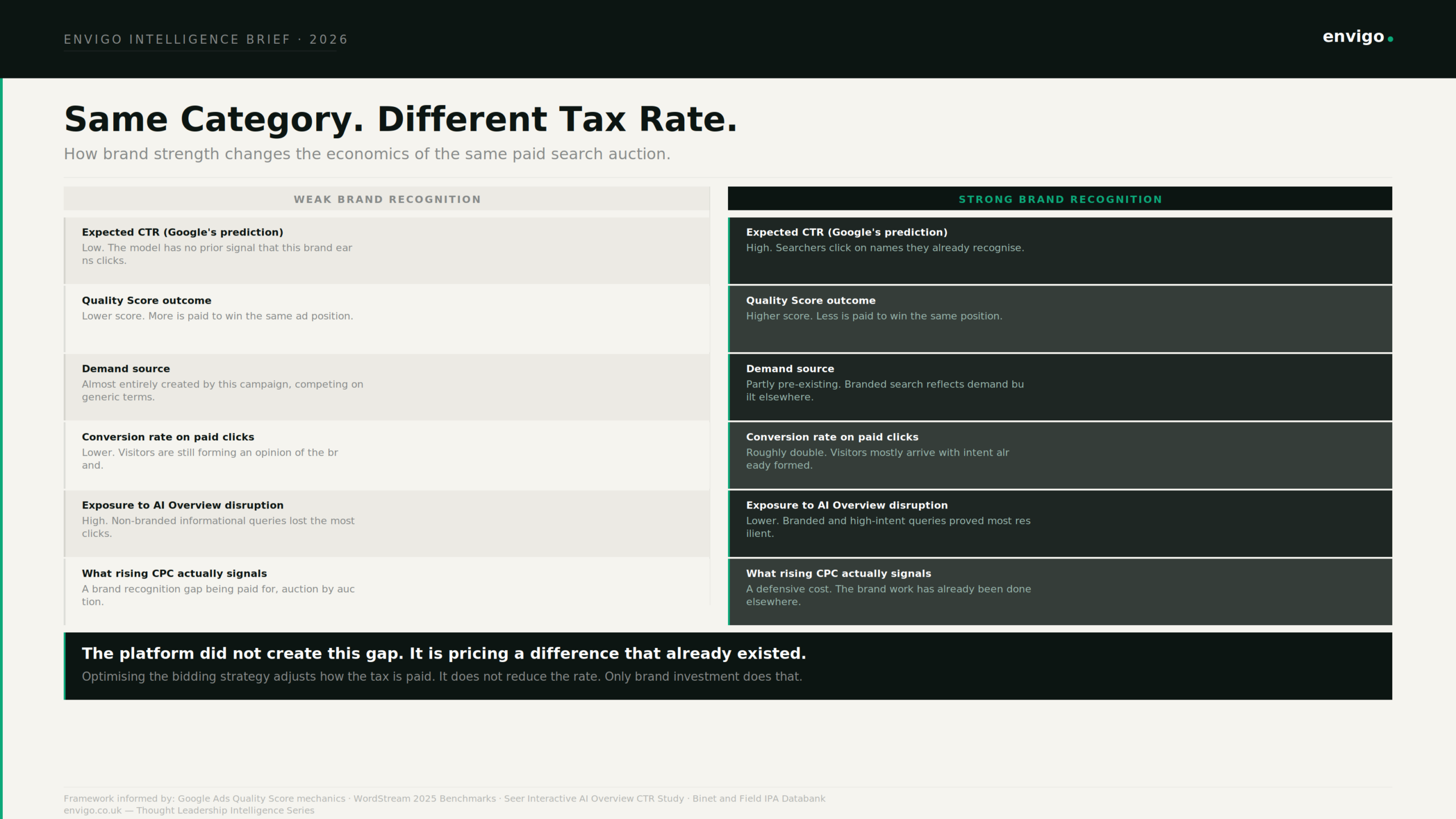
A brand with strong recognition is not paying less because its paid search team is more skilled. It is paying less because Google’s prediction model has more evidence that people already want to click on that name. That evidence was not built inside the paid search account. It was built through years of consistent visibility, genuine market presence, and the kind of brand investment that produces recall before a search ever happens.
This connects directly to the broader pattern in marketing measurement that has shaped every part of this discussion. The 60/40 principle established by Binet and Field says that durable marketing performance depends on sustained brand investment alongside short-term activation and that explains exactly why this gap exists in paid search specifically. Brand investment is not separate from performance marketing efficiency. It is one of the primary mechanisms that determines performance marketing efficiency. An organisation that underinvests in brand is not avoiding that cost. It is paying it later, at a compounding rate, inside every paid search auction it runs.
The Reframe This Requires
The question worth asking in the next paid search budget review is not whether the CPC trend can be optimised further. Optimisation within the auction has a ceiling, and most well-run accounts are already close to it. The more useful question is what proportion of the current CPC is a media efficiency problem, and what proportion is a brand recognition problem being expressed through a media channel.
A higher CPC can deliver a higher-quality, further-down-funnel user and a lower CPA. The headline CPC number is increasingly a poor proxy for campaign health. This is true, and it is also incomplete. The more durable answer is not learning to tolerate a higher CPC. It is reducing the rate at which the tax is charged in the first place, which is not something a bidding strategy can do. Insulation from continued CPC inflation comes from organisations that have built high-quality, proprietary signals the platform’s bidding algorithms can use but the more fundamental insulation is the brand recognition that determines the price before the auction even begins.
Sources: WordStream by LocaliQ 2025 Benchmarks · Search Engine Land · CPC Trend Analysis and LinkedIn/Google Benchmark, 2026 · Dreamdata B2B Benchmarks Report 2026 · Seer Interactive AI Overview Click-Through Rate Study, via Search Engine Land 2026 · HawkSEM Branded Keyword Performance Analysis · Statista Global Paid Search Advertising Forecast 2026 · Binet and Field · The Long and the Short of It (IPA)
Where to go next
If you’re dealing with comparable constraints, we’re open to a conversation.