
The Website Redesign Solved the Wrong Problem. Again.
Nearly 80% of website redesigns fail. That figure has appeared consistently across agency post-mortems, client retrospectives, and platform performance audits for years. It does not appear to have changed the way most redesigns are initiated. ThrillX
The reason is specific: most website redesigns are not started because the data identified a problem a redesign could solve. They are started because the people inside the organisation have grown bored of looking at the same site. That is a real experience. It is not a valid brief.
What Triggers a Redesign
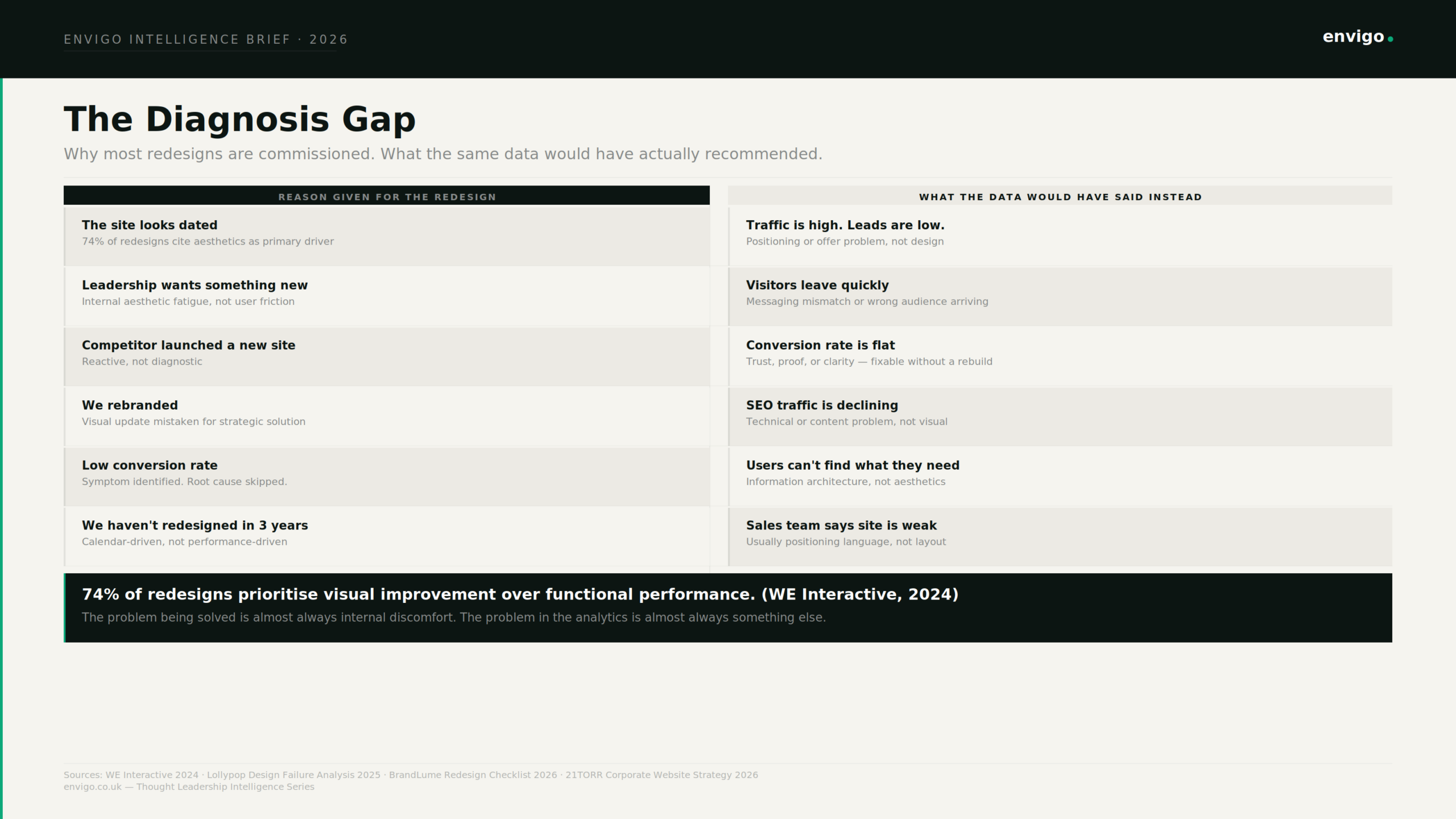
In 2024, research indicated that 74% of redesigns prioritise visual flair over functional performance. The trigger is almost always aesthetic. The site looks dated. A competitor launched something new. Leadership has seen a site they prefer. The agency contract is up for renewal and a redesign makes a natural scope. The brief that follows from these triggers describes what the new site should look like. It rarely describes what problem the new site should solve. Lounge Lizard
This matters because design is not the answer to most website performance problems. Design is the answer to a narrow set of problems (unclear visual hierarchy, poor information scent, broken interaction patterns) and even those are usually solvable without a full rebuild. The more common problems that underperform websites present in analytics are positioning problems, messaging problems, audience problems, and content problems. A new layout cannot fix any of them. It changes the wrapping around them.
The cycle this produces is recognisable in almost every sector. A B2B firm notices declining lead flow. The site is identified as the likely cause. A redesign is commissioned. The new site launches six months later, attracts a short burst of attention, and then settles back to approximately the same lead performance as before. The problem was never the design. The problem was that the site’s value proposition was indistinct, the content was not answering the questions buyers were actually asking, or the audience arriving from paid and organic channels was not the right audience. The redesign did not touch any of these. It made the site look newer while the underlying problem continued.
What the Data Would Have Said
A study by Forrester found that a well-conceived user interface can increase conversion rates by 200%. That is real, and it is also not an argument for a full redesign. A well-conceived interface built on top of a weak message produces a conversion rate improvement on the wrong visitor for the wrong reason. The most valuable thing Forrester’s finding tells us is that UX quality matters, not that a new site is the mechanism for achieving it. VWO
The analytics dashboard on most websites contains the answer to the question a redesign is meant to address. If qualified traffic is arriving and not converting, the problem is almost certainly not visual. Most redesigns start with a mood board and end with a beautiful site that users still find confusing, because UX was treated as aesthetics rather than as the study of how people actually navigate and make decisions. MCI France
The pages generating pipeline are almost always a small number. Most sites have three to five pages responsible for the majority of qualified enquiries. Redesigns routinely restructure or delete these pages without ever knowing what they were doing. The lead flow drops. The attribution model reports no clear cause. The team starts preparing the next brief.
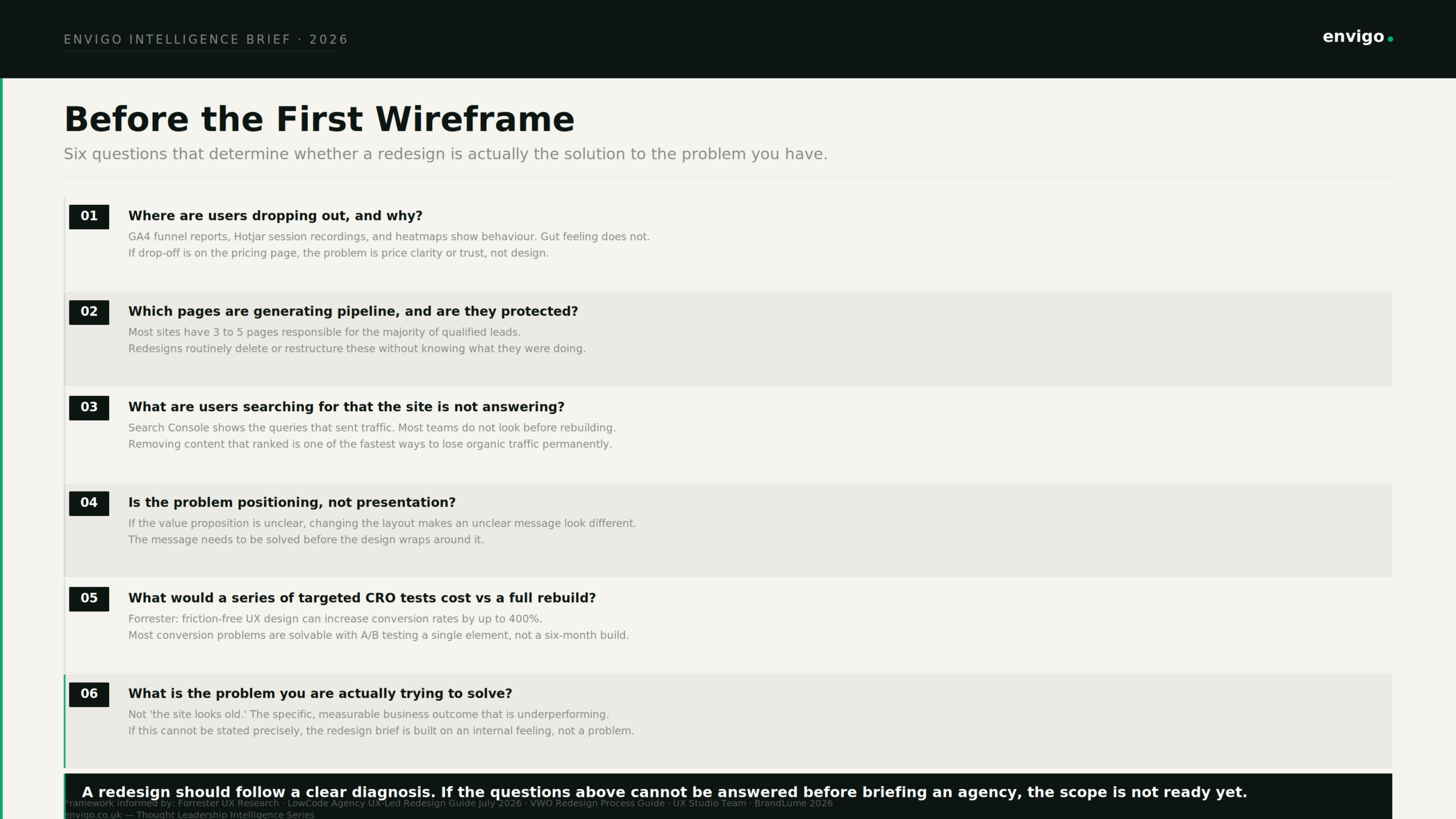
The questions that determine whether a redesign is actually the solution are diagnostic, not visual. Where are users dropping out, and why? Which content is generating organic traffic on terms that indicate purchase intent? Is the value proposition clear to someone encountering the brand for the first time, or is it clear only to people already inside it? What would a targeted conversion optimisation programme cost versus a full rebuild, and which has the higher probability of solving the identified problem?
Most redesign briefs do not contain these questions because the brief was written before the diagnosis was done.
What a Redesign Silently Breaks
The technical cost of a redesign is separate from whether it solves the right problem, and it is almost always larger than anticipated.
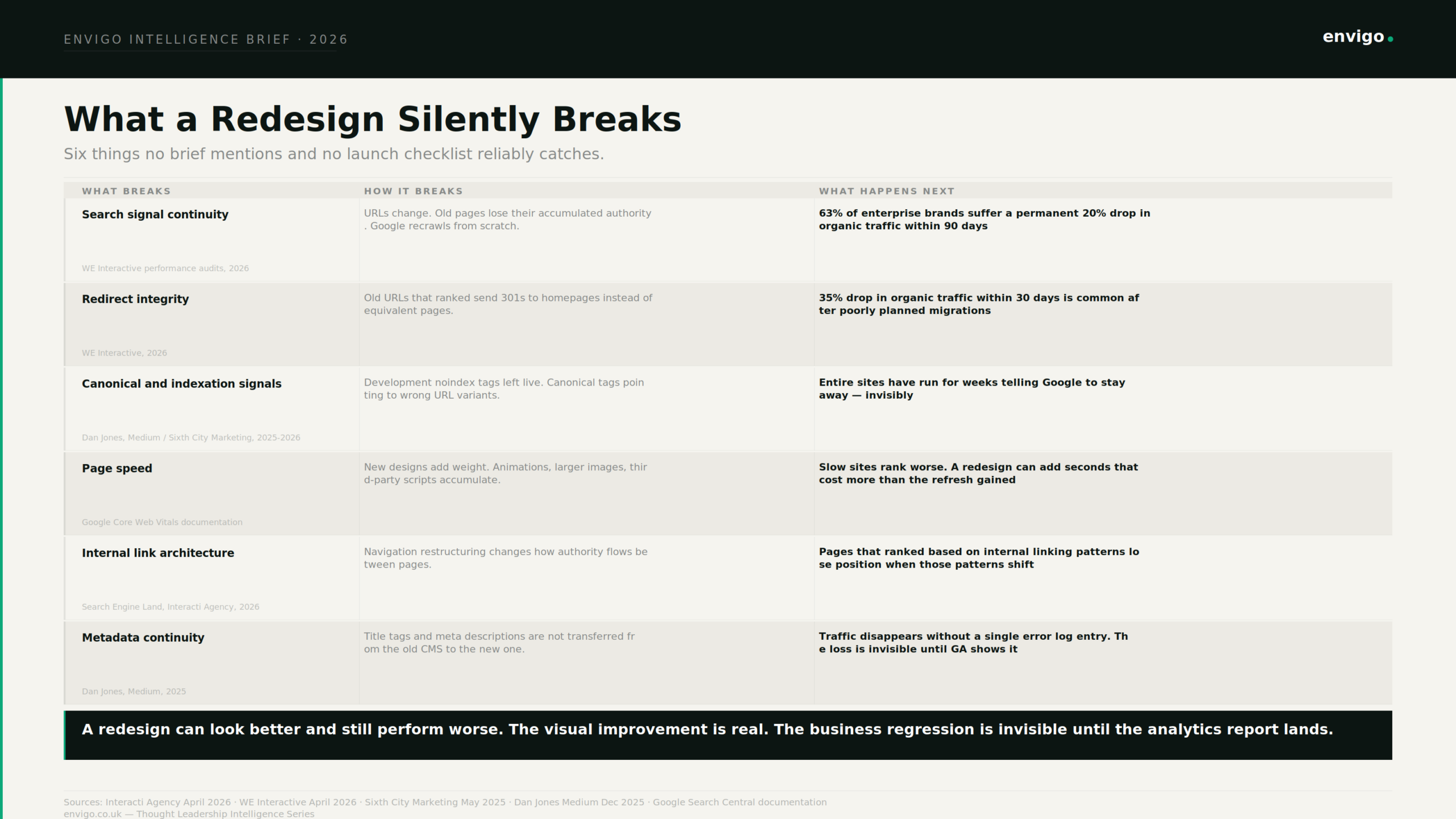
A botched migration often leads to a 35% drop in organic traffic within the first 30 days. Recent performance audits reveal that 63% of enterprise-level brands suffer a permanent 20% drop in organic traffic within the first 90 days of a redesign. The word permanent is doing important work in that sentence. This is not a temporary fluctuation while Google recrawls. It is a lasting reduction in organic visibility that reflects the loss of accumulated search signals that the old site held. UX Studio
The mechanism is consistent. URLs change. Old pages that ranked accumulate 301 redirects to pages that are structurally different, which weakens the signal transfer. Pages that should rank are launched with noindex tags left over from the staging environment. A redesign changes more than visuals. In many cases it also changes URL paths, heading structures, template code, internal-link placement, canonical rules, navigation depth, content blocks, rendering behaviour, and page speed at the same time. WE Interactive
When I see dramatic traffic drops after a redesign, this is usually where I start looking. You’d be surprised how often important pages simply disappear because nobody checked what was actually driving business before they deleted everything. Lowcode
Metadata is not automatically carried from the old CMS to the new one. Traffic disappears without a single error log entry. The loss is invisible until an analytics review identifies it, often months after launch. By then, the recovery requires rebuilding content that ranked, re-establishing redirect chains, and waiting for Google to recrawl a site that has been substantially altered. The loss compounds in the months it takes to notice and respond.
None of this appears on the brief. None of it is mentioned in the pitch. The risk is diffuse and technical and typically lands with a team other than the one that made the decision.
The Alternative
The alternative to a redesign is not inaction. It is diagnosis before prescription.
The specific problem should be stated as a measurable gap before any agency is briefed. Not “the site needs refreshing” but “qualified traffic is arriving at the services pages and leaving without converting, and we need to understand why before deciding what to change.” That framing produces a different scope (a UX audit, a content analysis, a conversion rate tes) rather than a six-month build.
Most website performance problems are solvable without a rebuild. Messaging that does not land can be refined in copy. Conversion problems on specific pages respond to A/B testing single elements (headline, proof point, form length, CTA) without touching the rest of the site. Information architecture failures, where users cannot find what they need, can be addressed through navigation improvements and internal linking without rebuilding the platform. The decision between rebrush, redesign, and relaunch should never be made on gut feeling. It emerges from the interplay of strategic goals, real user needs, technical constraints, and the current market position.
A redesign is the right solution in a specific set of circumstances. When the technical debt of the current platform is preventing improvement. When the information architecture is fundamentally broken at a structural level. When the brand positioning has changed substantially enough that the existing site is actively misrepresenting what the organisation does. When the platform cannot support the performance, accessibility, or integration requirements the business now has. In these cases, a rebuild is the right decision and it should be made with full awareness of what it will cost technically, commercially, and in terms of organic visibility.
Outside these conditions, a redesign is the most expensive, most disruptive, and most frequently misapplied tool in digital marketing. Initiated by internal aesthetic fatigue, executed against the wrong brief, and measured against the wrong outcome.
The website is often the symptom’s location, not the symptom’s cause. Finding the cause requires looking at what the data is showing, not at how the homepage feels in a weekly leadership meeting. The organisations with the highest-performing websites are rarely the ones with the most recently rebuilt ones. They are the ones with the clearest understanding of what their site is supposed to do, why it is currently failing to do it, and which specific intervention will address that failure most directly.
A redesign is sometimes that intervention. More often, it is the most expensive way to avoid the harder question.
Sources: Lollypop Design 80% Failure Rate Analysis December 2025 · WE Interactive Website Redesign Strategic Checklist April 2026 · Interacti Agency Redesign Traffic Recovery Guide April 2026 · BrandLume Redesign Mistakes Guide May 2026 · Dan Jones Medium – Website Traffic After Redesign December 2025 · LowCode Agency UX-Led Redesign Guide July 2026 · Forrester UX Research · 21TORR Corporate Website Strategy February 2026 · Google Search Central Site Migration Documentation
Where to go next
If you’re dealing with comparable constraints, we’re open to a conversation.