
AI Has Made Content Cheap. It Has Made Credibility Expensive.
AI Has Made Content Cheap. It Has Made Credibility Expensive.
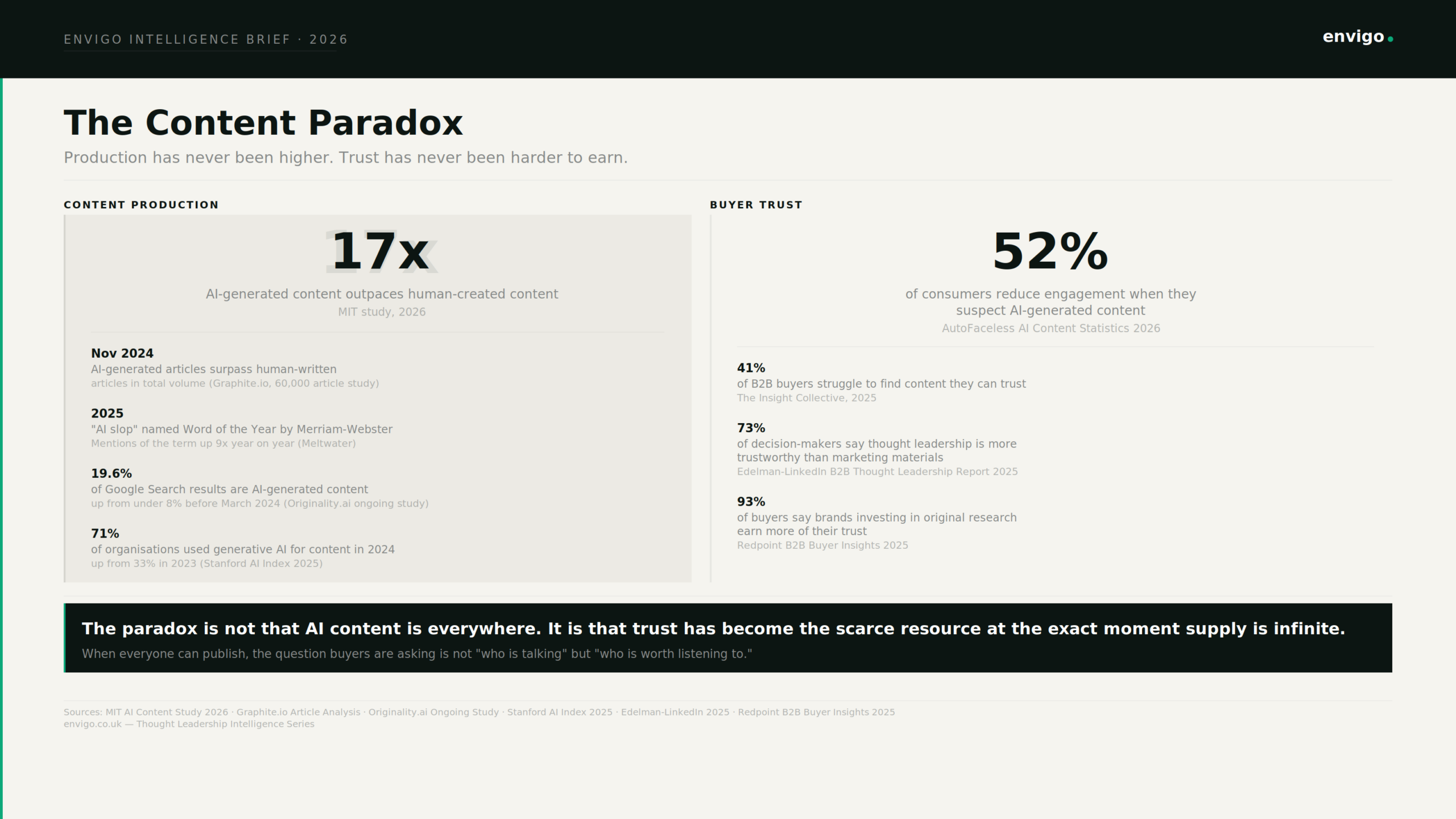
By November 2024, the volume of AI-generated articles on the web had surpassed the volume of human-written ones. According to a study by Graphite.io examining more than 60,000 articles from 2020 through 2025, AI-generated content crossed that threshold by late 2024 and continued growing into 2025. Marketing Week
The practical result is a web where the constraint is no longer production. Merriam-Webster and the Australian National Dictionary both named “AI slop” their Word of the Year for 2025, with mentions of the term up ninefold year on year. Buyers now enter every content interaction with a prior assumption that what they are reading may have been assembled rather than written, averaged rather than observed, and published to fill a calendar rather than to say something. Marketingscience
52% of consumers reduce their engagement when they suspect AI-generated content. That number will not stay at 52%. It will rise as detection becomes easier and the volume continues to grow. Smiling CFO
What the Trust Gap Looks Like
41% of B2B buyers say they struggle to source content they can actually trust. That figure was collected in a market where AI-generated content was already widespread. It reflects not a lack of content but a loss of confidence in it. Peelresearch
Generic content is now doubly penalised. It is ignored by humans and useless to the AI systems that are increasingly mediating discovery. A keyword-targeted article that restates widely available information serves neither the reader who has already read it elsewhere nor the AI model that treats it as noise in a training set full of the same. Tamarind
When asked which content earns the most trust, 93% of buyers said brands that invest in original research earn more of their trust. That figure has been consistent across multiple years of buyer research. It has not changed because AI arrived. What changed is how expensive it now is to ignore it. Dovetail
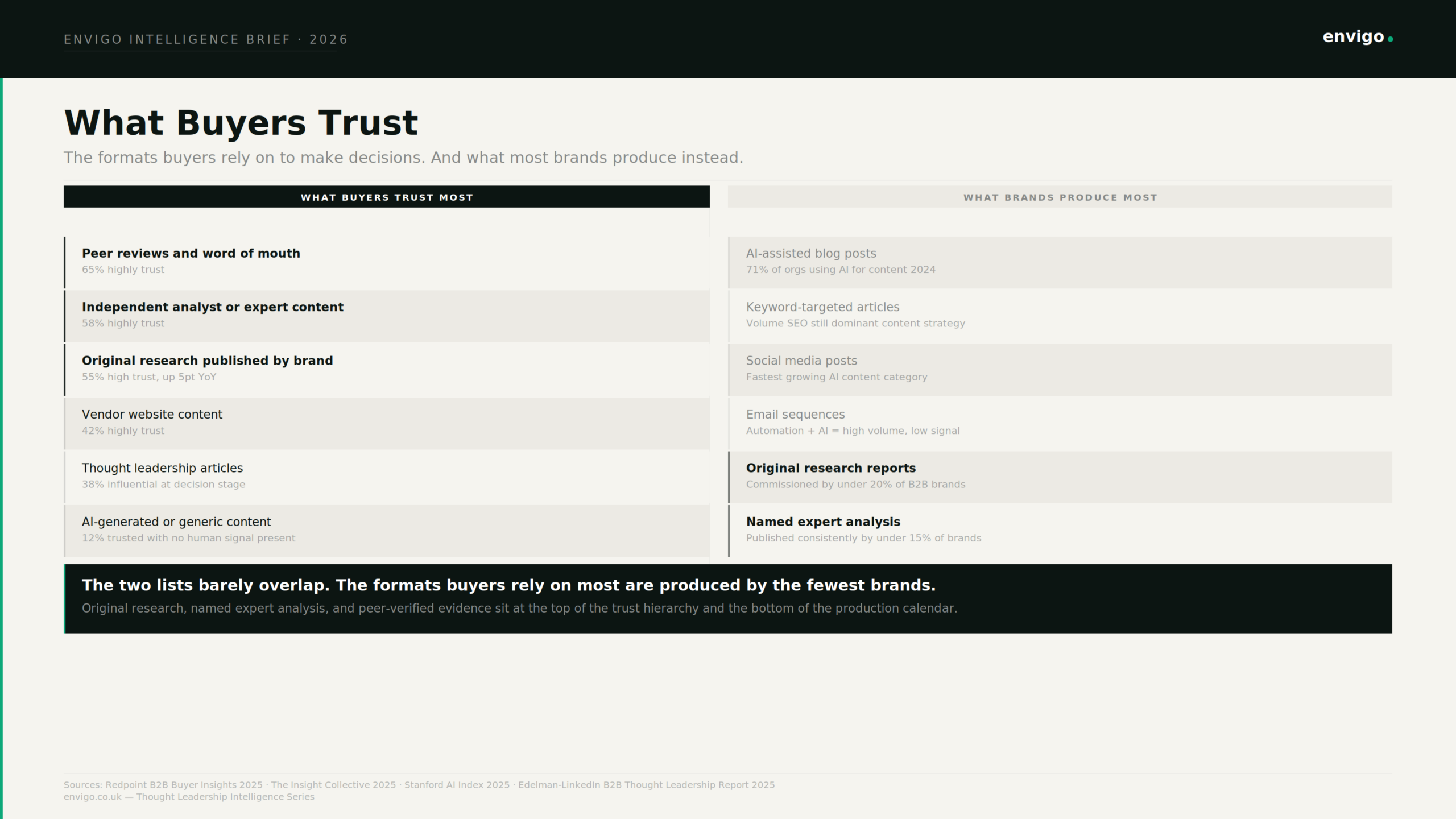
The formats buyers rely on most are peer reviews, independent expert analysis, and original research. 42% of buyers say they highly trust content from vendor websites, behind peer reviews at 65% and independent analysts at 58%. Vendor content can earn trust but only when it is substantive enough to compete with those other sources on the quality of its thinking. Dovetail
The Two Lists That Barely Overlap
Most content strategies are built around what is easiest to produce at scale. AI-assisted blog posts. Keyword-targeted articles. Social posts. Email sequences. These formats are fast to produce, easy to measure by volume, and visible in channel reporting.
They are also the formats buyers trust least when making significant decisions.
Thought leadership is more effective than traditional marketing materials at reaching hidden buyers. The internal influencers who are not in the room but whose alignment or resistance shapes whether deals progress. More than 40% of B2B deals stall due to internal misalignment within buying groups. RED C
The most successful thought leadership feels authored and discussed by industry experts themselves. It is not the language of a marketing team. When executives actively share insights on platforms and at events, the impact multiplies because buyers trust individuals they perceive as genuine practitioners. Ignition Blog
The gap between what buyers trust and what brands produce most is not closing. The organisations running AI-assisted volume programmes are widening it in the wrong direction.
Why First-Hand Experience Has Become the Scarcest Signal
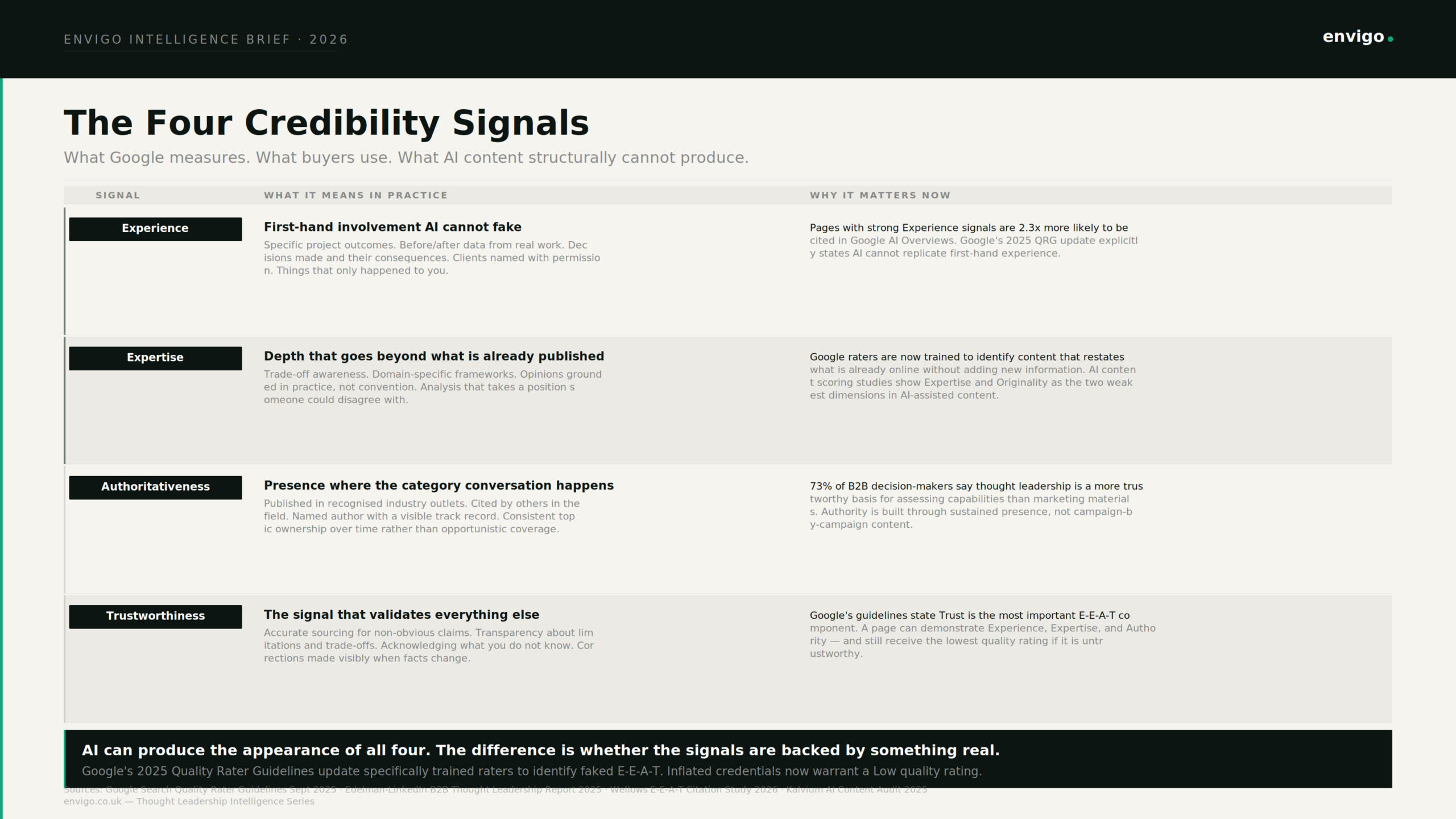
In December 2022, Google added a second E to its quality framework, creating E-E-A-T. Experience is the new quality rating. It considers the extent to which the content creator has first-hand experience with the topic. Medium
The timing was not coincidental. Google’s 2025 Quality Rater Guidelines update is explicit that AI cannot fake first-hand experience. This is the single most diagnostic dimension for AI-assisted content. Blogger
According to a Wellows study analysing 2,400 AI Overview citations, pages with strong E-E-A-T signals are 2.3 times more likely to be cited. The signals that matter are specific project outcomes, before-and-after data from real work, named clients with permission, and decisions made and their consequences. These are things that only happen to you if you did the work. Dreamdata
Google’s guidelines are explicit that Trust is the most important E-E-A-T component. A page can demonstrate experience, expertise, and authority, but if it is untrustworthy the E-E-A-T evaluation is low regardless of the other signals. In 2025, updates to the quality rater guidelines focused specifically on identifying unhelpful AI content. Inflated or faked credentials now warrant a Low rating, and raters are instructed to conduct in-depth off-site research rather than accepting quick claims. MarketingscienceMarketingscience
AI can produce the appearance of all four E-E-A-T signals. The difference is whether those signals are backed by something real. A product review from someone who used the product carries more weight than a summary compiled from other reviews. That distinction is now structural to how both Google and buyers evaluate content.
What Changed and What Did Not
Nothing about this is new. Original research, named expertise, and genuine first-hand analysis have always been the foundation of brand authority. The decade of performance marketing that preceded AI made it easy to underinvest in these things because the volume tactics produced measurable outputs. Rankings. Clicks. Lead volumes. The credibility gap was present. The measurement did not show it.
Trust is the one thing AI cannot shortcut. As generative content floods every channel, the scarce resource is no longer information itself but credibility. AI can produce content at infinite scale. It cannot produce the original insight, the lived expertise, or the institutional reputation that makes content worth trusting. Tamarind
As Rob Mitchell, formerly of FT Longitude, puts it: good thought leadership by definition involves original insight, which is currently something that AI cannot do. For now, this creates a competitive moat around genuine thought leadership. That moat is the most valuable real estate in B2B marketing right now. Tamarind
Sources: Graphite.io Article Volume Study 2025 · Merriam-Webster Word of the Year 2025 · Meltwater AI Slop Report 2025 · Edelman-LinkedIn B2B Thought Leadership Impact Report 2025 · Redpoint B2B Buyer Insights 2025 · The Insight Collective 2025 · Google Search Quality Rater Guidelines September 2025 · Wellows E-E-A-T Citation Study 2026 · AutoFaceless AI Content Statistics 2026
Where to go next
If you’re dealing with comparable constraints, we’re open to a conversation.